Children in Gaza need life-saving support
UNICEF continues to work with partners to provide assistance to children and their families.

Conflict in Gaza has taken an unconscionable toll on children. More than 64,000 children have reportedly been killed or injured, and homes, hospitals and schools have been destroyed, depriving families of safety and essential services. More than 56,000 children have lost one or both parents, while widespread displacement, malnutrition and trauma continue to shape every aspect of childhood in Gaza.
Impact on children | UNICEF’s response | What we're calling for
How children and families in Gaza are being affected
For children and families across the Gaza Strip, everyday life is shaped by severe and compounding harms, as the systems they rely on for survival have been decimated. Humanitarian needs remain staggering. Grave violations against children and protection risks remain widespread, while the extreme scale of trauma is driving urgent mental health needs.


Extensive damage to water, sanitation and waste management infrastructure has left nearly the entire population of the Gaza Strip exposed to public health risks. At the same time, the destruction of health facilities, combined with overcrowded and unsanitary living conditions, has fueled disease outbreaks and constrained access to care.
High levels of malnutrition continue to threaten the survival of children in Gaza, with potentially lifelong devastating consequences on their health and wellbeing. Meanwhile, attacks on schools – many serving as shelters for internally displaced people – have severely hampered the resumption of learning, potentially setting back children’s educations by years.
How UNICEF is supporting children in Gaza
UNICEF staff have remained on the ground, working with partners day in and day out to meet the most urgent needs of children and families in Gaza. The current ceasefire must afford humanitarian actors the opportunity to safely resume at scale the massive response that the children of Gaza so desperately need.

Where and when access is possible, UNICEF is active in the following areas. For the most up-to-date information, read our Situation Reports.
Response
Prolonged hostilities and repeated displacement have left almost every school in Gaza destroyed or severely damaged, while taking a profound psychological toll on children. Education consistently emerges as one of the most urgent priorities for children and their families, offering a vital step towards recovery, healing, and a sense of normalcy. UNICEF is leading efforts to restore learning opportunities for all 658,000 school-aged children in Gaza by scaling up temporary learning spaces.
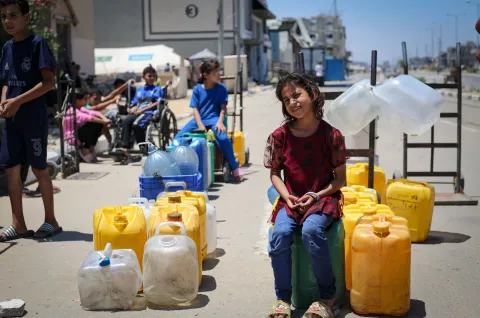
Restoring safe and reliable access to water and sanitation is critical to addressing malnutrition among children and preventing further public health risks, particularly as Gaza endures winter conditions marked by flooding and disease outbreaks. UNICEF is supporting the restoration of water supply and distribution systems, including the rehabilitation and operation of public and private desalination plants.
Intense bombardment, displacement and the widespread destruction of medical infrastructure have left many children without access to even the most basic care. Routine immunization has been interrupted, maternal and newborn services severely disrupted, and preventable diseases are rising rapidly. Restoring essential health services is critical to prevent further deaths and to lay the foundation for recovery. UNICEF’s health response continues to focus on re-establishing primary healthcare, restoring immunization coverage, and ensuring the availability of life-saving neonatal and pediatric care.
Expanding social protection is essential to reduce the extreme vulnerability of children and their families – and to help prevent the further deterioration of their living conditions. Multi-purpose cash assistance enables families to meet their basic needs, while reducing the risk of famine and preventing further malnutrition among children.
There is an urgent need to scale up child protection and mental health interventions to mitigate the long-term psychological and physical impact of extreme violence, displacement, and loss. Protecting all children from further harm and addressing their mental health needs at scale are among UNICEF’s highest priorities.
High levels of malnutrition continue to endanger the lives and wellbeing of children in the Gaza Strip, while malnutrition among pregnant and breastfeeding women is having a cascading impact on thousands of newborns. Despite some progress in treating and preventing acute malnutrition, thousands of children under five remain acutely malnourished. UNICEF continues to deliver critical nutrition services to support the detection, treatment, and prevention of acute malnutrition among vulnerable children and pregnant and breastfeeding women.
Support UNICEF’s work for children
What is UNICEF calling for?
- All parties must fully uphold their obligations as set out in the ceasefire agreement.
- Displaced people must be allowed to move freely and voluntarily return to their homes as soon as possible.
- Full, unfettered movement of humanitarian aid into Gaza. This includes humanitarian aid and commercial trucks entering at scale, with improved and faster clearance procedures, and all possible supply routes being open.
- National and international humanitarian staff have regular and unfettered access through several entry points to and from the Gaza Strip. Freedom of movement for humanitarian staff within the Gaza Strip is also a critical requirement of the provision of aid in a ceasefire context.
- The specialist supplies and staff needed to carry out unexploded ordnance detection and removal must be permitted entry to the Gaza Strip and must not be impeded in their operations, including coordination.
- A lasting political resolution that prioritizes the rights and well-being of this and future generations of children.
Is UNICEF operational in Israel?
In high-income countries such as Israel, Governments generally have adequate capacity to respond to emergencies. Upon request from the Government, UNICEF can extend support, such as mental health and psychosocial support for children.
In over 30 countries where UNICEF does not perform programmatic activities, National Committees for UNICEF serve as our dedicated voice, helping to raise funds for UNICEF’s work worldwide, to promote children’s rights, and to lift visibility for children threatened by poverty, disasters, armed conflict, abuse and exploitation. The Israeli Fund for UNICEF was established in 2009 to raise awareness of children’s rights in Israel and fundraise for UNICEF’s life-saving work across the world.
*Updated 5 August 2026